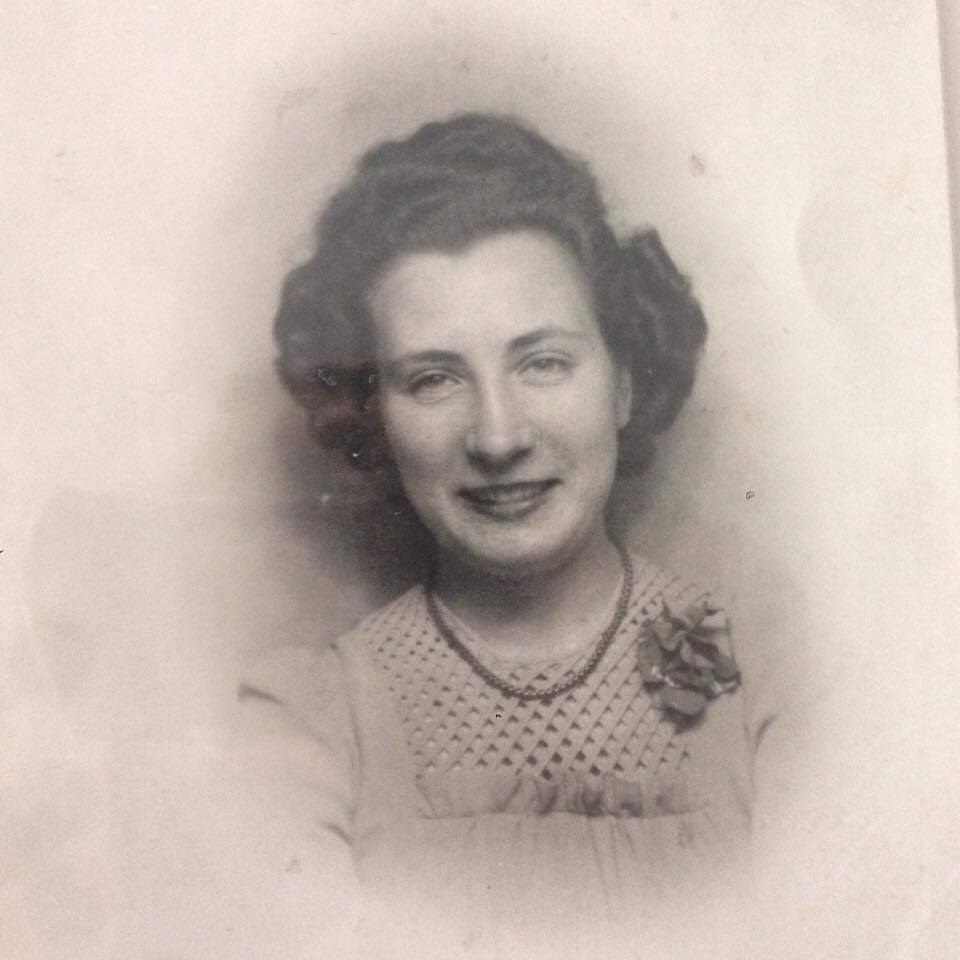
October is World Blindness Awareness Month and here at H2A this is something which is close to our hearts, well especially Amy’s which is why I have the pleasure of writing this one. I apologise in advance for the informal tone in this blog, but with a topic this personal there’s only one way to write. One of my nearest and dearest friends also happens to be my 92-year-old grandmother who I can honestly say is one of the biggest inspirations and motivations in my life. This woman may be 92 years of age, living predominately independently, in her own home but she is also registered blind. Talk about strong women, right?
Olive, my amazing grandmother, was diagnosed with the degenerative eye disease, Retinitis Pigmentosa at the young age of 13 back in 1938. Even today there isn’t a cure for this disease, I believe there is treatment to prolong the individuals sight but nothing which completely stops the degeneration. My grandmother wasn’t the only individual in her family to have been diagnosed with Retinitis Pigmentosa, also having a couple of siblings who had the disease. So, what is it? Retinitis Pigmentosa is an inherited genetic eye disease which affects the retina located at the back of the eye. It causes permanent changes to the vision of the individual, but how much and how quickly after diagnosis differs from person-to-person. This is because the disease involves the cells of the retina gradually failing to work and eventually dying, stopping the eye’s ability to process light and therefore vision. Retinitis Pigmentosa can exhibit different symptoms depending on the individual. Most have trouble seeing in poor light and a loss of peripheral vision, whilst less commonly, which is the case for my grandmother, individuals experience the loss of central vision and can only catch glimpses of vision out of their periphery.
At the age of 92 my grandmother’s eyesight has almost completely gone, however that hasn’t always been the case, and I would believe the past 10-15 years has seen the greatest deterioration. For many people with this condition they are fortunate enough to see clearly for most of their life, with some minor adjustment, however by 50 years of age the vast majority will notice significant deterioration, meaning small tasks which previously had seemed relatively easy, become harder to manage. My nan was 66 years old when I was born, and from a very young age I have only fond memories of her day to day activities whilst managing her condition and still finding time to engage with my brother and I in fun stuff. We visited her most days after school and she always had time to show and teach us new things and take us places. She would take us on a day trip to the local town centre, including using the bus service, managing two young children with absolutely no assistance, and we weren’t always the best behaved.
I suppose I must have been made aware from an early age that my grandmother was different, there were some small tasks which she could not perform without some aid. I recall she had a clock which spoke the time when a button was pressed. One of the fondest memories I have is one of me standing on a wooden chair baking with her and listening to her scales sing out the weight to us. I didn’t know my grandmother when she was first diagnosed with Retinitis Pigmentosa and was told she would eventually lose her sight, but for me she is special and the greatest example of triumph through adversity. She rarely complains about her loss of sight and has always taken small challenges in her stride, she raised three boys and then took care of me and my brother from a very young age, not to mention also taking care of a puppy late into her 70’s.
I appreciate that there are many causes and symptoms of visual impairment/blindness and I appreciate that my grandmother is not alone in her determination to lead a normal life despite her long-term condition. I have nothing but the utmost respect for the day to day challenges many must face and I feel humbled by their fortitude.
My nan is incredible, I wish I could show her off to the world as an example of a strong woman challenging the stereotype around disability. I can empathise that being diagnosed with a visual impairment can be shocking and scary and I want to highlight that as challenging as it might seem, you can still live a fulfilling life. My grandmother married, had three sons, seven grandchildren, a great grandchild on the way, she’s worked most of her life, in many disciplines, she’s travelled, experienced the world, she felt all the things you’d expect of a 92-year-old woman, love and loss. But she’s still standing, strong and sassy. However, her life wouldn’t have been as full and easy without the help of some extraordinary people and organisations.
For many people with a disability or impairment the first people they can depend upon to care and support them is their family. And that is certainly the case with my grandmother. Her main source of care currently is myself, my dad and brother. However, a charity that I must give a huge amount of recognition to is the Royal National Institute of Blind People (RNIB). This organisation does a tremendous amount of good work to provide information, support and research for individuals and their loved ones who have a visual impairment. It is this charity who provide my grandmother with her most loved pastime, being able to read. The RNIB provide her with a free of charge audio book service which means that she can constantly be listening to a variety of books at her leisure and the RNIB deliver them direct to her door. They are also the charity responsible for all the other talking devices I discussed earlier, without which my grandmother’s life would have been much more difficult. They do amazing work and I encourage everyone to follow them and support their work.
So, what is my call to action for this blog? For many people, if they don’t have a relative who is visually impaired then they won’t have the opportunity to observe not only the challenges that they face but also the brilliant work that national organisations and charities are doing. Therefore, all I’m asking is that you make yourself more aware of these brilliant individuals and the wonderful support out there. Go look on the RNIB or the Fighting Blindness websites, educate yourself on the different forms of blindness and learn about all the hard work they’re doing in research and community action. And if you have some free time, engage with your local community, understand what support there is for people who are living with a visual impairment and possibly do some volunteer work. There are many people who will not be as fortunate as my grandmother to have close family support even a small amount of interaction or a friendly face will make all the difference to that individual. In addition, you never know, you may meet an amazing individual who will inspire your life the way my grandmother has inspired me.